Japanese Gothic by Kylie Lee Baker
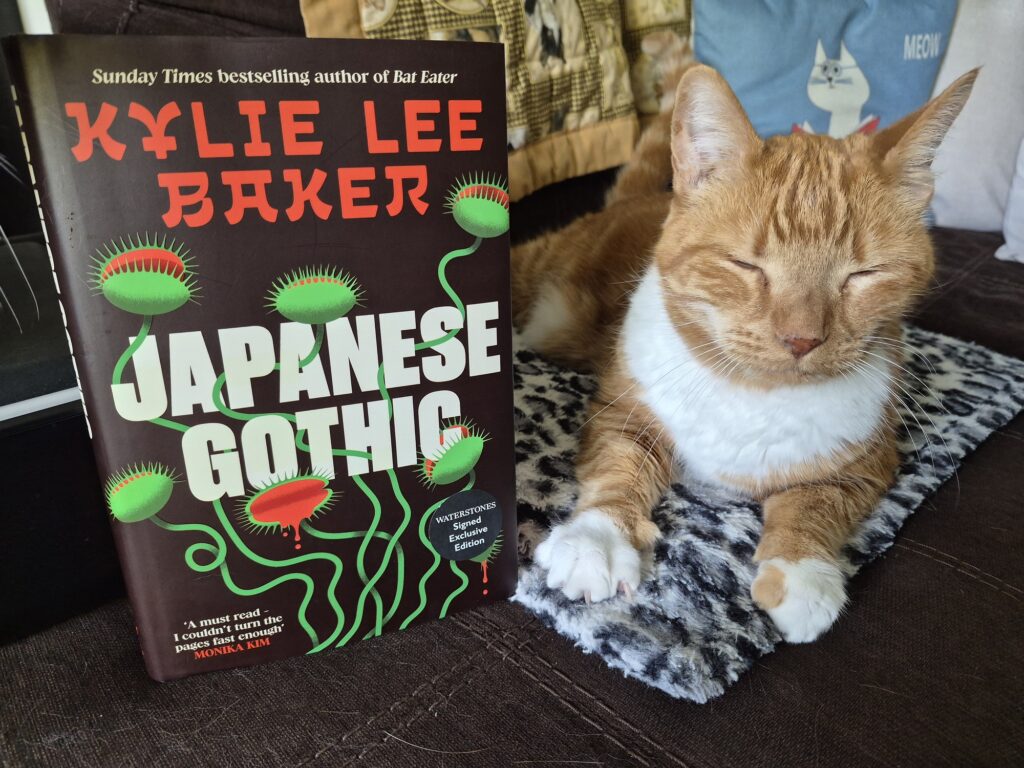
There are two reasons why I bought Japanese Gothic: 1. The word “Gothic” in the title. 2. It is a dual timeline story supposedly involving a ghost. Japanese Gothic is an unexpected read. I think I like it, but it’s hard to tell with the melancholy I feel every time I think about it.
In 2026, college student Lee Turner has fled the US for Japan to stay at an old house surrounded by sword ferns in Kagoshima Prefecture that his father has purchased. Lee believes he has killed his roommate, but he can’t remember why he would have killed him, or how he killed him, or what he did with his roommate’s body. Lee is also burdened with the grief of his mother’s disappearance when he was a child while they were on a trip to Cambodia. It is suspected his mother is a victim of sex trafficking, but Lee is haunted by the image of his mother’s body stuffed inside a suitcase, begging him to let her out.
In 1877, a teenager named Sen is training to be a samurai, even though women are not meant to be samurai. She and her family are hiding out from the imperial government in the same house that Lee’s father purchases in the future because her father and the other samurai failed at the Satsuma Rebellion. Her father should have done the honourable thing and died in the rebellion with the other samurai; instead, he lives with his shame in surviving. Even though he is a harsh teacher towards Sen, she is devoted to him and her training.
Lee and Sen have the same room in the house, which has a closet door that inexplicably opens onto a concrete wall. One night, Lee notices a glowing light behind the closet door and when he opens it, he meets Sen. Lee is convinced that Sen is a ghost because she is from the past, and he thinks that because she is a ghost, she can help him find a way to communicate with his dead mother. In exchange, Lee will find out how Sen died.
When I first started reading Japanese Gothic, I wasn’t sure that I wanted to read a novel with a protagonist who is allegedly a murderer, but Lee is a sympathetic character with his missing mother and his arm’s length relationship with his father. He is consumed by his trauma, and his trauma consumes the story, but Baker’s writing is so eloquent that there is almost a beauty to his mental deterioration and the horror of his intense urge to crawl into a suitcase himself so he can experience what he believes his mother experienced.
A suffocating sense of isolation permeates the novel through the lives that Lee and Sen live in the little house surrounded by sword ferns. Lee is afraid to leave the house because of the crime he thinks he has committed, and Sen cannot leave the house because of the danger to her family. Lee and Sen are two very different people from two very different times, but they are inextricably linked by their bondage to the house with the sword ferns. I didn’t even guess at the mystery of how the house connects Lee and Sen or how the novel was going to end, I just knew it was going to be sad. I think this is a novel that I will end up reading again at some point in the future.