Our Cut of Salt by Deena Helm
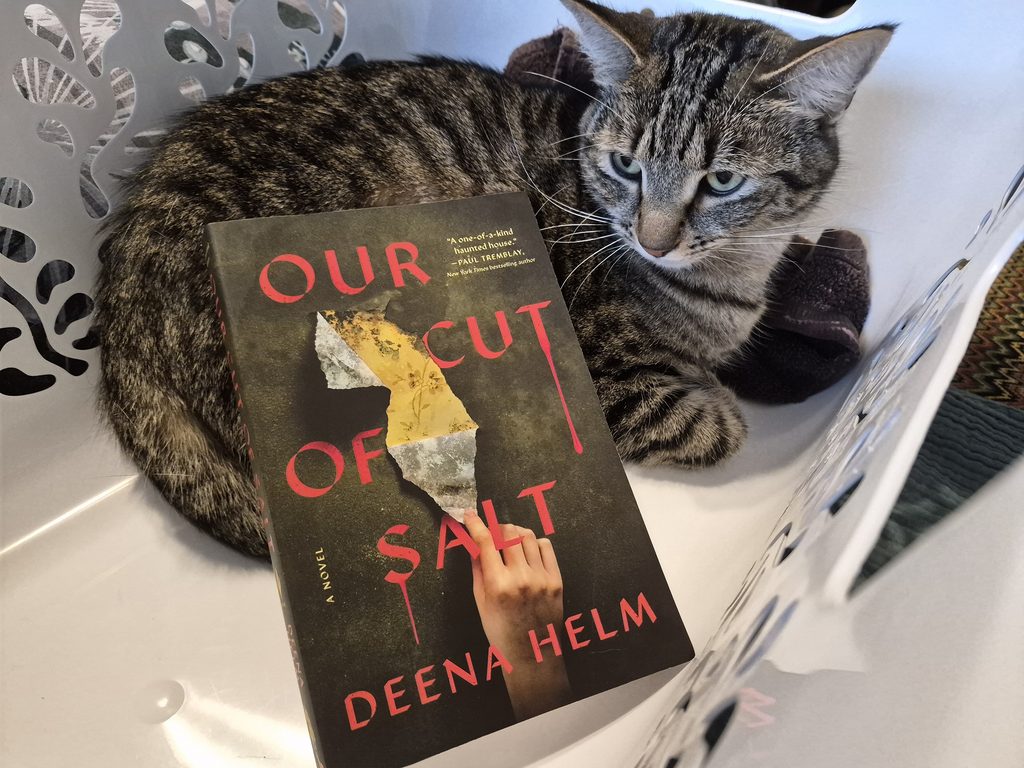
Our Cut of Salt is Palestinian American author Deena Helm’s first novel and is a haunted house story about the traumatic effect of the 1948 Nakba on three generations of Palestinian women. Our Cut of Salt has the potential to be a very good story, but the storytelling is unfortunately hampered by not-so-great writing.
Our Cut of Salt begins in Chicago in 2002. College grad Marina has been tasked with travelling to Nazareth to retrieve the belongings of her grandmother who has recently died, Nuhad, but Marina also wants to go to Haifa, where Nuhad lived in her childhood home until the Nakba. Marina’s mother, who is named for the city that Nuhad never saw again after her family was forced out by the Israeli settlors, does not want Marina to go to Haifa, but she reluctantly agrees. Once in Haifa, Marina meets Nuhad’s childhood best friend, Rania, who tells her that Nuhad’s childhood home is haunted and that since 1948 no one has lived in it for very long because people tend to disappear once they move in. This doesn’t stop Marina from visiting Nuhad’s house, and the house, that has been festering in anger since the settlors forced Nuhad’s family to leave, begins haunting Marina and making her sick.
Although Our Cut of Salt features a haunted house, it is not a scary novel. I knew that going into this book, so I am not disappointed by the lack of frights. Our Cut of Salt is instead a psychologically haunting novel and while the descriptions of the house devouring the settlors is a bit gruesome, the real horror of this novel is how Palestinians are forced to live in our world. I felt so anxious for Marina as she is racially profiled at the airport for being Arab, spat on by Israeli children for wearing a keffiyeh headband, and required to carefully navigate the streets of Haifa so she doesn’t get shot by trigger-happy Israeli soldiers. I also felt anxious for Nuhad and her family after they are forced to leave Haifa and try to rebuild their lives in Nazareth while new Israeli settlements inch closer and settlors with guns strapped to their backs move through their streets and patronize their businesses. It is but a small glimpse of the trauma and horror that Palestinians have had to live with since 1948.
The writing in this novel, though, almost made me quit reading before I had even finished the first chapter. At the beginning, I felt like I was reading word salad; I had to re-read sentences two or three times to try to make sense of them. The writing eventually starts to flow a bit better, but then there is just so many repetitive phrases that it becomes annoying to read. Helm would have benefited from an editor who encouraged more concise writing.