The Marrow Thieves by Cherie Dimaline
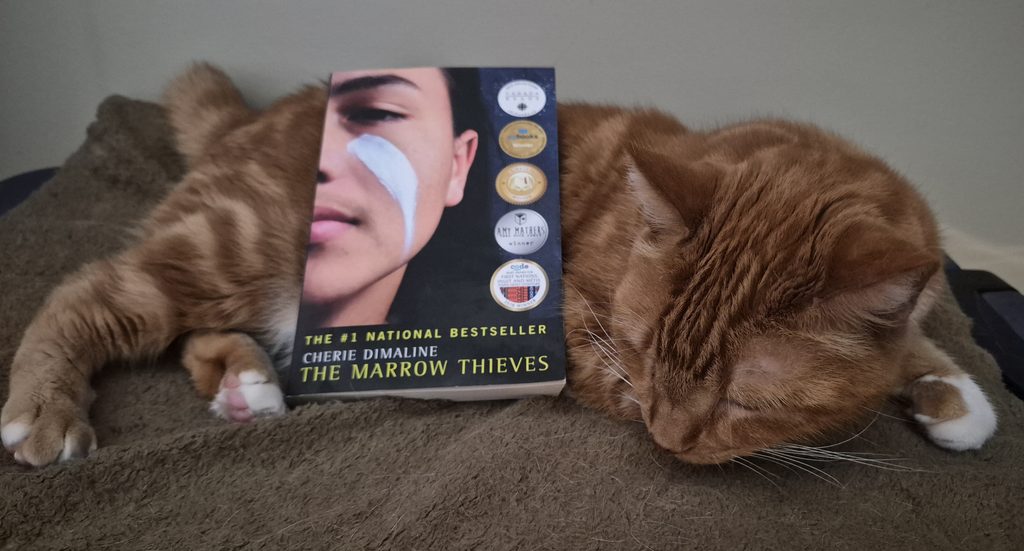
The Marrow Thieves sat in my TBR pile for a long time because I wasn’t sure I was ready for another story that was going to make me sad as well as infuriate me. But my TBR pile recently got low enough that it was time to read The Marrow Thieves, and I am glad that I did. It makes sense that this powerful story has ended up on so many “best book” lists.
The Marrow Thieves is set in a near-future where climate change and human activity have had devastating consequences on the world. The sea has risen which has led to coastal flooding, killing millions of people and forcing the survivors to move inland; lakes are poisoned and nothing that lives in them is consumable; animals have evolved or mutated or something, I am not quite sure because it is only fleetingly mentioned in the story, but I guess don’t fuck around with guinea pigs in the future?
But another thing that has happened is that people have lost the ability to dream. How, I don’t know as it is another thread that I wished Dimaline had pulled on, but she didn’t, and I guess it doesn’t really matter because the consequences of people no longer being able to dream – depression, suicide, anarchy – are not justification for what happens to the Indigenous people in this story, just as there has never been justification for the way white people have treated Indigenous people.
You see, Indigenous people are the only people in The Marrow Thieves that can still dream, and it has been discovered that their ability to dream can be extracted from their bone marrow, so this leads to new residential schools being opened up to house Indigenous people before they are murdered for their marrow. This is dark and horrifying for a YA novel, and I am really curious if not being able to dream would actually lead to this because we don’t usually remember if we dream anyways. The only dreams that I remember are the stressful dreams I have about work, so I am okay with not being able to dream. But dreams are important to Indigenous people as dreams are connection to the spirit world and their ancestors, so if white people have already taken their land, then the only thing left to take from Indigenous people is their spirit.
The protagonist for The Marrow Thieves is a teenage boy called Frenchie who has lost his entire family and is on the run from the Recruiters, the people who hunt down Indigenous people to take them to the schools. Frenchie joins the group of an Indigenous man named Miigwans who is leading orphaned Indigenous children through northern Canada where they will hopefully be safe from the Recruiters. Frenchie feels like an authentic teenage character. He doesn’t fully understand what has led the world to its current state where his people must live their lives on the run, and the reader learns alongside him as truths are revealed to him. He is forced to grow up quickly and learn to be responsible for his group, but he still becomes consumed by petty teenage jealously when the girl he has a crush on pays attention to another boy.
The whole time I read The Marrow Thieves I felt this sense of dread that there is no way this novel can have a happy ending. Frenchie, Miigwans and the rest of their group start running out of places to hide from the Recruiters as the government expands its operations further north and they can never be sure of who they can trust as some of their own people work with the Recruiters. But the ending, although not a happy one, is an ending full of hope. As climate change worsens, I think Indigenous people, who have always been stewards of the land, are going to be the ones with the greatest ability to heal the land that is being destroyed by greedy billionaires with their oil fields and AI data centres.