Playground by Richard Powers
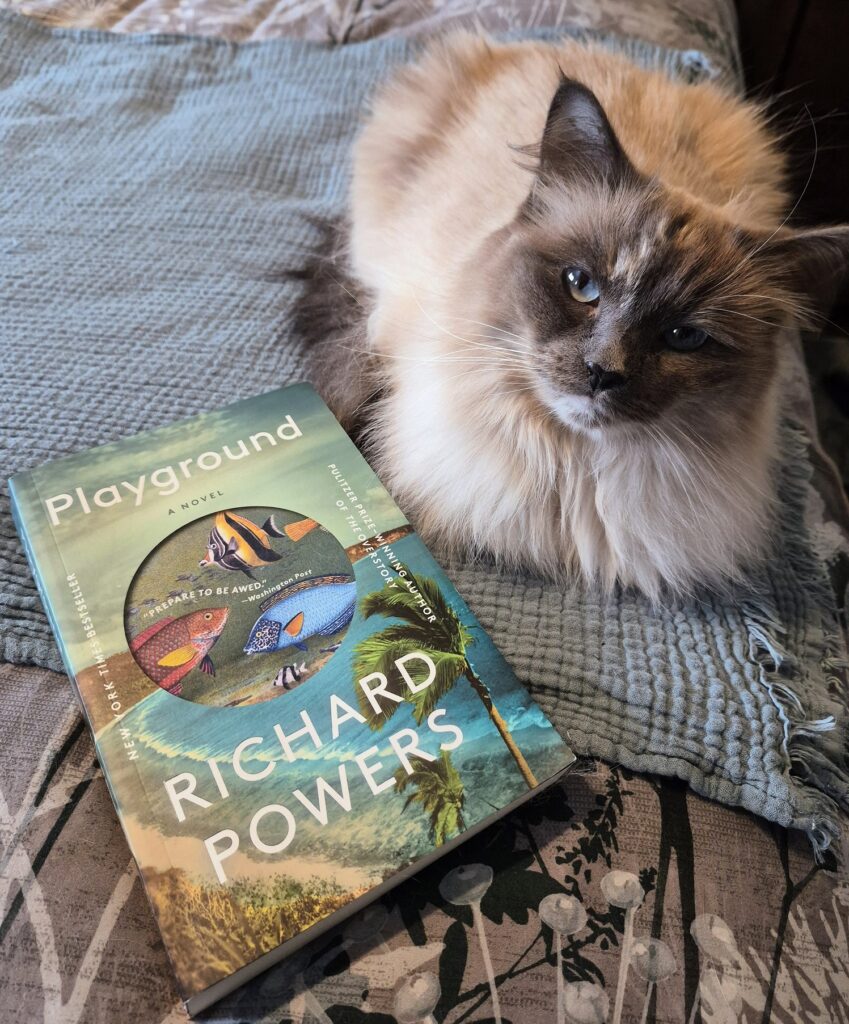
After reading Richard Powers’ dense novel, The Overstory, Playground is definitely a much easier read, but there are many different thematic threads woven through Playground that I found myself feeling disoriented about what the novel is supposed to be about, and then the end hit me with a sledgehammer and left me feeling devastated.
There are three related narratives to Playground. The first narrative is about Makatea, a French Polynesian island populated by a colourful cast of characters but still recovering from devastating environmental degradation caused by European colonizers. There are about 80 inhabitants left on the island, including American couple Ina and Rafi, who must decide via referendum whether they want to allow an American company that plans on building floating cities in international waters to set up base on their island. The Americans are offering jobs, money and infrastructure for the island, but at what cost to Makatea’s fragile ecosystem?
Another resident on Makatea is ninety-year-old French Canadian Evelyne Beaulieu, a famous scuba diver. The novel follows her journey as she overcomes a lot of sexism to be taken seriously as a female scuba diver and marine biologist. Evelyne also grapples with being a wife and mother when all she wants from life is to be in the ocean.
The main narrative that pulls all three stories together is that of tech billionaire Todd Keane. Todd recounts his life story from how he became interested in coding as a child, to how he became best friends with Rafi and met Ina, and the events that led to the three of them falling out. Richard Powers is a powerful storyteller in the way that he makes even the narcissistic Todd a compelling character. Todd is at the forefront of the development of AI, even though he knows it has the potential to destroy humanity, but Todd is more interested in satisfying his ego than altruism. Think Steve Jobs, or even Mark Zuckerberg, just older and less of a geek. Todd is a terrible person who lacks empathy and the ability to appreciate human creativity outside of technology, but I found myself very much engrossed in his story.
The ending of Playground, as I already mentioned, surprised me and devastated me, not only because of the fates of the novel’s characters, but because of the implications of AI’s future. Right now, AI is still like a child that needs to be taught by its human parents, but what happens when AI surpasses its teachers? What happens when it takes away our jobs and leaves us unemployable, and not only jobs in technology, what if AI learns to be creative? What if AI learns to tell a better story than humans? What will we do when even our imaginations are replaced by an artificial imagination?